
Monica Bonvicini and the Inscription at the Japanese Palace
Blickwechsel: Schenkung Sammlung Hoffmann / Japanisches Palais
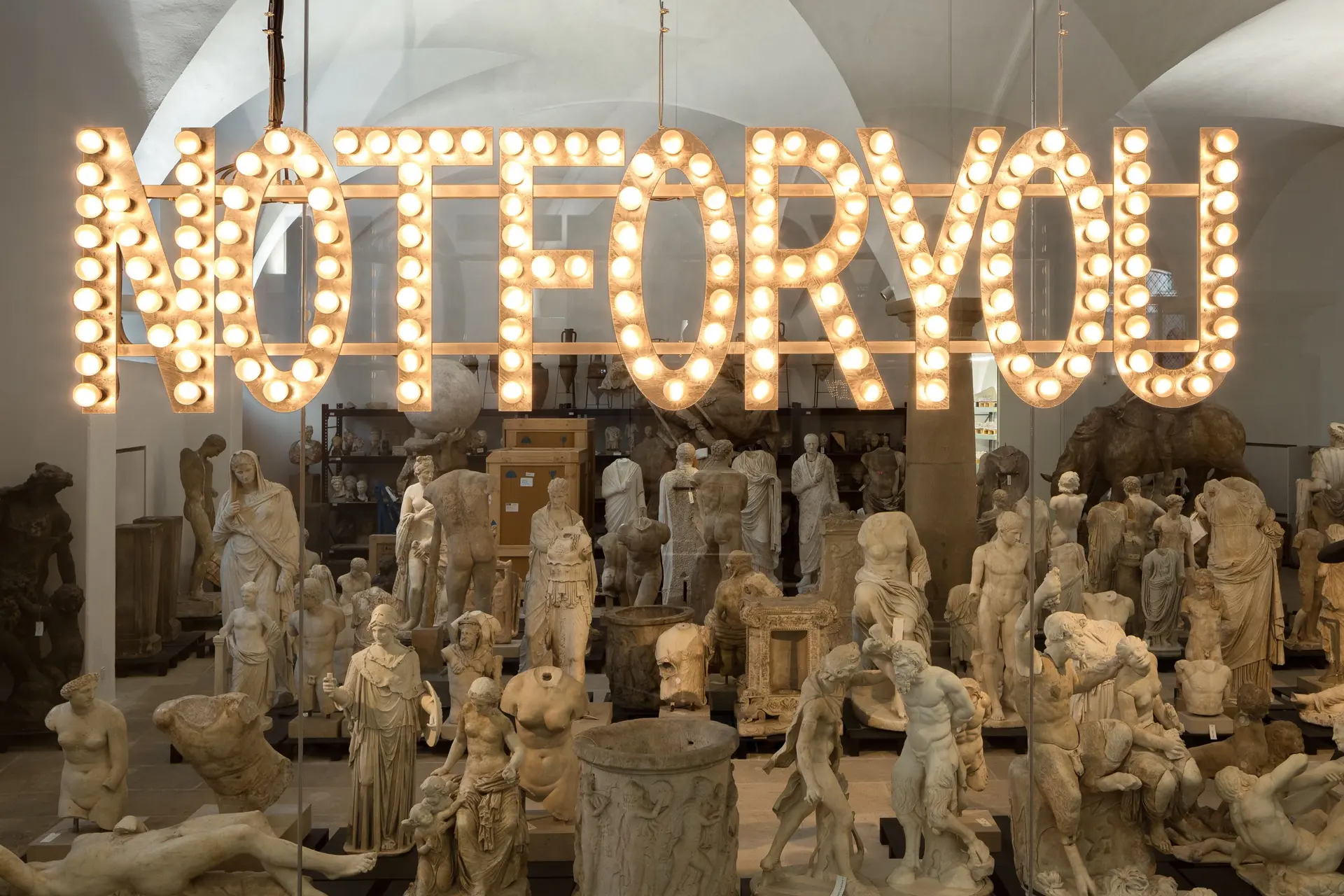
Monika Bonvicini’s works are characterised by a critical view of our society. Her light installation instantly catches the eye with letters almost a metre in height formed from light bulbs. The work, drawing on aesthetically striking elements from advertising, has great visual appeal: The brightly flashing letters are reminiscent of neon signs, like those in front of cinemas or bars designed to attract customers with their enticing glow. Yet whatever the promise of flickering light, Bonvicini transforms it into an aggressive, almost blinding flickering that delivers the message like a domineering warning signal. NOT FOR YOU stirs a desire in us and proscribes it at the same time. This push and pull between attraction and exclusion is a central theme in many of Bonvicini’s works. Using language as a tool, she reflects on and criticizes social power relations, control and paternalism. The monumental dimension of her installation is consistent with her approach to space, whereby the phrase, always in dialogue with the respective location where the work is installed, can take on varying meanings and may elicit questions about the mechanisms and social structures of the space or the institution that is behind it.
- Exhibition Site Japanisches Palais
- Dates 18/11/2026—07/12/2026
- Opening Hours Wednesday to Sunday 10—17
- Admission Fees admission free
In dialogue with the
In dialogue with the Japanese Palace, the sentence questions the structures underlying the building. Today’s Japanisches Palais has its origins in the Dutch Palace acquired by Augustus the Strong in 1717. It was intended to house his significant collection of East Asian porcelains, primarily from China and Japan. Extensive conversion was planned for the so-called Porcelain Palace. The rivalry between recently developed Meissen porcelain, which went into production in 1708, and the East Asian collection is reflected in the architectural articulation of the palace: The upper floor, reserved for Meissen porcelain, rests symbolically on herms and atlases on the courtyard side. These monumental supporting figures by Johann Christian Kirchner and Johann Matthäus Oberschall depict Asian people in particular, and though the expressions are striking, these are stereotypical and exoticizing representations, reflecting the Eurocentric view of the Baroque period. At the same time, a desire to pursue world knowledge and an interest in the “foreign” is present in these depictions. The building housed various electoral collections as early as 1721. With the renovation from 1782 to 1786, it became a publicly accessible museum – as indicated by the Latin inscription on the main portal: “Museum usui publico patens” (museum open to public use).
The words NOT FOR YOU stand in contradiction to the inscription. This juxtaposition addresses the power relations and mechanisms of control inscribed in the collections of the Staatliche Kunstsammlungen Dresden since their origins, and which we may sense when looking at the unusual herms and atlases at the so-called Porcelain Palace. With its provocative statement, the light installation declares the democratic ideal of universal and barrier-free cultural participation null and void. With its angry, flickering lettering, the work confronts us with the social dimension of a museum space that is embedded in societal structures and creates identity within them. But identity for whom? not for you articulates something that usually remains unspoken, but which nevertheless gives shape to social life in virtually all areas: forms of exclusion and the underlyingpower structures in political decisions, social spaces and creative processes. Bonvicini’s work thus becomes a critical commentary on museums as places that not only make participation possible but also limit it.
Slider


Ausstellungen


Rodney Graham and the Velvet Saddle of the Wettin Princesses
in Residenzschloss

